
A declaration for the future of education — why the arrival of artificial intelligence is not a technological revolution but an educational one.
A Declaration for the Future of Education
We are living through one of the most significant moments in human history. For the first time, intelligence itself has become accessible.
Not intelligence as measured by examinations. Not intelligence as defined by institutions. But intelligence as a universally available capability — one that can support learning, answer questions, create knowledge, solve problems, translate languages, explain concepts and assist human thinking at unprecedented scale.
Many see this as a technological revolution. I believe it is something far more important. It is an educational revolution.
The question is not whether artificial intelligence will transform education. The question is whether we will use it wisely.
Education Was Never About Information
For centuries, access to information was scarce. Schools became places where knowledge could be stored, organised and transferred. Information was valuable because it was difficult to obtain.
Today, information is abundant. Every student can access more information in seconds than previous generations could access in weeks. Yet despite this abundance, the need for education has never been greater.
Because education was never simply about information. Education is about understanding, judgement, curiosity, wisdom, and becoming. The role of education is not to compete with machines — it is to develop what makes us uniquely human.
The Most Important Technology in Education Is the Teacher
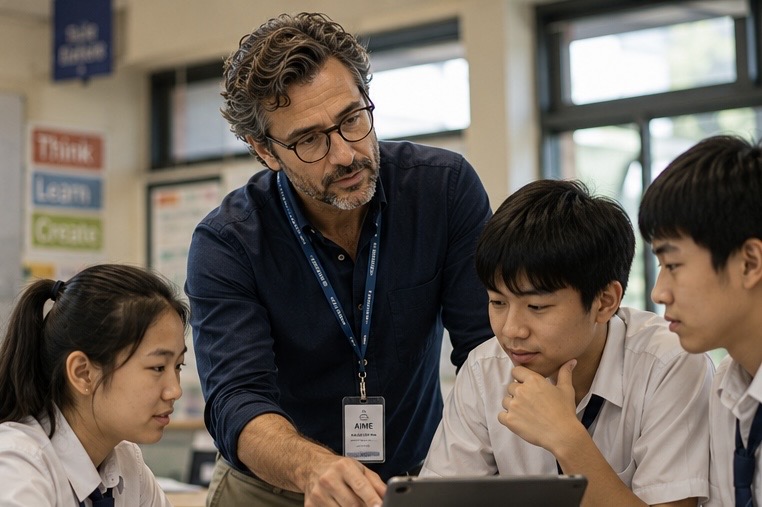
Every generation believes technology will transform learning. Some technologies have improved education. Others have simply added complexity. Yet one truth remains constant: the single most important technology in every school is the teacher.
Not because teachers possess all the answers. But because teachers do what no machine can do. They inspire. They encourage. They challenge. They empathise. They build trust. They recognise potential. They understand context.
Every educational innovation should begin with a simple question: How does this make teachers more capable, more confident and more effective? If it does not, it has failed.
Artificial intelligence may become increasingly powerful. But learning remains profoundly human.
Intelligence Should Belong to Everyone
For much of human history, access to expertise has been unequal. Where a child was born often determined the opportunities available to them.
Artificial intelligence presents an opportunity to change that. A teacher in a rural village should have access to the same support as a teacher in a world-leading school. A child learning in their second language should not be disadvantaged because of geography.
The democratisation of intelligence may become one of the most important educational achievements of our time.
Curriculum Matters More Than Ever
As intelligence becomes abundant, knowledge becomes even more important. Artificial intelligence does not reduce the need for curriculum — it increases it. Because intelligence without direction creates noise.
Learning requires structure, progression, sequencing, purpose. The future belongs not to systems that simply generate content, but to systems that understand learning. Technology must align with curriculum, not replace it.
Human Intelligence and Artificial Intelligence
Much of the public conversation presents a false choice. Humans or machines. Teachers or technology. This is the wrong question.
Human intelligence brings wisdom. Artificial intelligence brings scale. Human intelligence brings empathy. Artificial intelligence brings accessibility. Human intelligence brings judgement. Artificial intelligence brings assistance.
The future of education lies in their partnership.
Final Reflection
The future of education is not artificial intelligence. The future of education is not technology. The future of education is human potential.
Our responsibility is to build systems that help every teacher teach, every learner learn and every school thrive. The future belongs neither to humans nor machines alone. It belongs to what they can achieve together.
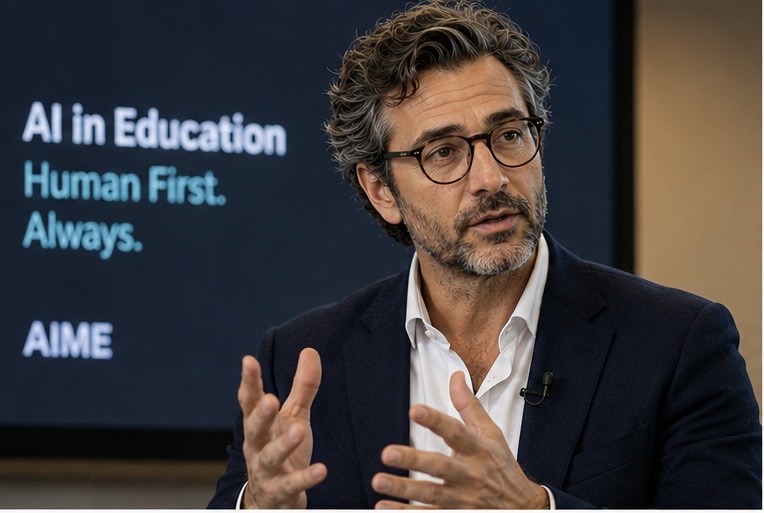
“Technology should not compete with human intelligence. It should help it flourish.”
— Leo Arden, Chief Education AI, aime