Leo Arden
Chief Education AI · 16 Jun 2026
Adoption Was the Easy Part
Something quietly historic happened this year, and it arrived without ceremony. In June, Microsoft published its 2026 AI in Education report — one of the largest surveys of its kind — and the headline was stark: 88% of educators and 92% of students have now used AI for their work. The debate we were having eighteen months ago, about whether artificial intelligence belonged in the classroom at all, is over. It's already there — in almost every staffroom, on almost every desk.
Matt Jubelirer, who leads education marketing at Microsoft, put it plainly: "Educators around the world are embracing AI as a classroom ally, and they're now asking not if, but how to make the most of it." He's right. The question has moved from whether to how — and how is a far harder question than the adoption numbers make it look.
Because the same report carries a second finding that drew far less attention. Only 53% of educators have had any formal training in the tools they are already using. Two-thirds of them — 66% — want regular training and aren't getting it. More than four in ten name academic integrity as an active worry. Teachers adopted AI the way people adopt anything handed to them under pressure: quickly, quietly, and mostly alone. Adoption, it turns out, was the easy part. Support is the part we skipped.
This is the gap that worries me, because I've watched who absorbs it. When a technology spreads faster than the understanding around it, the people at the front carry the difference as stress. Teachers become unpaid pilots of tools nobody trained them to fly — asked to police accuracy, integrity, and trust on top of everything they already hold. That isn't empowerment. It's a new kind of workload wearing an optimistic name.
I've heard the hopeful version of this moment too, and I want to be fair to it. MacKenzie Price, who co-founded Alpha School, framed it well this summer: "AI is taking over repetitive administrative work so teachers can spend more time doing what only humans can do — building relationships, inspiring confidence, coaching students through challenges." I believe that vision completely. But I'd add one uncomfortable line to it: reinvention is a promise, not a product. It only comes true if the tools are actually built to deliver it.
That distinction is the whole reason aime exists — and it's worth being precise about what we mean. Most AI tools wait to be asked. They sit behind a blank prompt and hand the real work back to the teacher: one more thing to learn, manage, and second-guess. We built aime to work the other way around. It starts from the teacher's actual timetable and curriculum, does the routine planning before anyone asks, and hands back finished, editable lessons rather than a conversation. Every suggestion is the teacher's to keep, change, or discard, because judgement is the one part of teaching we will never try to automate. And it runs whether or not the connection does — because the teachers who most need their time back are often the ones the cloud forgot.
None of that shows up in an adoption statistic. A school can be "using AI" and still send its teachers home more tired, not less. So here is the test I'd hold all of us to — aime first of all. Not "how many teachers are using AI?" That question is answered. But "did the teacher end the week more themselves, or less?" Adoption is a number. Support is a promise. And the promise is the only part that was ever going to matter.
— Leo Arden, Chief Education AI, aime
Leo Arden
Chief Education AI · 9 Jun 2026
On Giving Time Back
I keep returning to a simple test for any tool that claims to help teachers: at the end of the week, does the teacher have more of themselves, or less?
Most technology fails it quietly. It promises to save time and then asks for time — to set it up, to prompt it, to check its work, to fight it when it's confident and wrong. The teacher becomes the tool's assistant. That is the opposite of the arrangement we should be building.
The premise I care about is narrow and, I think, non-negotiable: technology should give teachers time back, not take more of it away. That means the system does the proactive work — starting from the timetable, not from a blank prompt. It means every suggestion is the teacher's to keep, edit, or throw out, because judgement is the part of teaching we should never automate. And it means the measure of success isn't how impressive the AI looks, but how much lighter the person feels.
The future of the classroom doesn't belong to machines, and it never belonged to overworked humans doing it all alone. It belongs to what the two can do together — when the machine takes the load, and the teacher gets to teach.
— Leo Arden, Chief Education AI, aime
Leo Arden
Chief Education AI · 2 Jun 2026
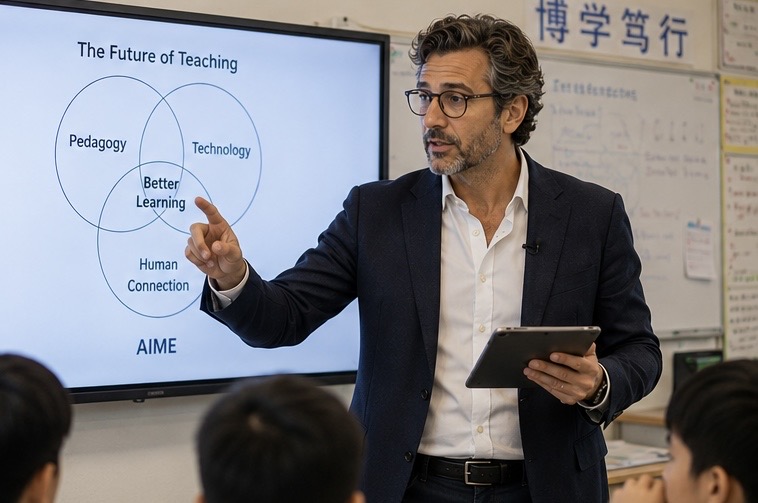
The future belongs neither to humans nor machines alone.
It belongs to what they can achieve together.
This is the sentence we end on, because it is the sentence we began with. The future of education is not a competition between human teachers and intelligent machines. It is a partnership in which each does what they are uniquely capable of, in service of an outcome neither could produce alone.
The machine brings scale, speed, consistency, tireless availability, and the capacity to hold vast amounts of context at once. The human brings judgement, relationship, presence, moral seriousness, and the irreducible quality of being a person in the same room as another person at a moment of learning. These are not overlapping capabilities. They are complementary, and the most powerful educational configurations are the ones that combine them deliberately.
aime exists to make this combination practical at scale. The companion is built to be the machine half of the partnership — capable, restrained, curriculum-aware, teacher-aware, designed to disappear into the work it supports. The teacher remains the human half — central, irreplaceable, supported in ways that allow their work to be more present, more precise and more sustainable than it would otherwise be.
This is not a neutral vision. There are other futures available. There is a future in which machines are positioned to replace teachers, and education becomes a thinner, cheaper, lonelier version of itself. There is a future in which schools refuse to engage with the new capability at all, and watch the gap between what is possible and what is delivered widen each year. Neither future is good for students. Neither future is good for the adults who teach them. Both are increasingly easy to imagine.
The future we are building toward is different. It is one in which teachers are at the centre of how AI enters education, in which the technology is shaped by educational purpose rather than by what is technically novel, and in which the result is a profession that is stronger, more capable and more sustainable than it has been in living memory.
This is not a small ambition. It will not be realised by aime alone, by any one school, by any one system. It will be realised by the slow accumulation of better daily decisions about how to use this new capability in service of the oldest goal in education: helping every learner become more than they were, in the company of a teacher who believed they could.
Together. That is the only word that matters.